The Mattress Guide
What to Look for in an Organic Mattress: Materials, Certifications, and Construction
An organic mattress is not defined by a single fiber, certification, or elegant label. Its character emerges from the materials beneath the cover, the way each layer is assembled, and the evidence behind claims about sourcing and safety. Here is a considered guide to reading beyond the marketing—and finding a mattress that suits both your standards and the way you sleep.
Published October 11, 2026
Shopping for an organic mattress can feel like entering a beautifully made room where every surface promises purity, comfort, and a better night’s rest. The language is appealing: natural, clean, breathable, sustainable. But these words do not always describe the same thing, and a mattress is a layered object. A cotton cover may be certified while the comfort layers beneath it are made from different materials. A mattress may contain wool or latex without every component being organic. Even two beds with similar ingredient lists can feel strikingly different once you lie down.
The more useful approach is to consider the whole construction. Ask what is in the cover, what makes up the comfort layers, what provides support, how the layers are joined, and what each certification actually verifies. Then bring the details back to your own needs: sleeping position, preferred firmness, warmth, movement, allergies, bed-frame compatibility, and care routine.
Naturepedic can be a helpful reference point while comparing organic mattress options, but no brand name should replace close reading. Treat each model as an individual design. Product specifications and certification coverage can vary, so check the current details for the exact mattress you are considering rather than assuming that a company-wide claim applies to every component.
Begin with the materials, not the headline claim
A mattress may combine several materials, each with a different role. The outer fabric affects first touch and breathability; quilting can add a little loft; comfort layers soften pressure at the shoulders and hips; and the support core helps maintain a stable sleeping surface. Understanding these jobs makes a materials list much easier to interpret.
Cover fabrics and quilting
Organic cotton is commonly used for mattress covers because it has a soft, familiar hand and allows air to circulate through the fabric. Check whether the claim refers to the cotton itself, the finished textile, or the complete cover assembly. Also note whether the surface is quilted with another material. Wool, for example, may appear in a quilted layer, while the cover fabric remains cotton.
A cover is the part you encounter first, but it is only one part of the mattress. A certified organic cover does not, by itself, establish that every layer inside is organic. Conversely, a mattress with a carefully documented natural filling may have a cover that follows a different certification pathway. Read the description component by component.
Latex: responsive, buoyant, and variable
Latex is valued in mattress construction for its springy response. Rather than slowly settling around the body, it tends to push back more promptly, which some sleepers experience as buoyant support. It may be used in one comfort layer or several, and those layers can differ in thickness, firmness, and processing.
When evaluating latex, look for precise language about the material’s origin and composition. “Natural latex” is not automatically interchangeable with “certified organic latex,” and neither phrase alone tells you how a mattress will feel. Ask which layers contain latex, how thick they are, and whether the manufacturer identifies their firmness or density. These details matter for comfort as much as the label does.
Wool and other natural fibers
Wool can be used in quilting or as a layer within the mattress. Its loft and ability to manage moisture can contribute to a comfortable sleep surface, though the sensation depends on the amount, placement, and construction. Cotton and other fibers may also appear in batting, padding, or fabric blends. For each material, distinguish between a natural origin and a certified organic origin; they are related claims, not synonyms.
Foam, adhesives, and less visible components
Look beyond the materials that appear in the first paragraph of a product description. Ask whether the mattress includes foam, synthetic fibers, fire barriers, adhesives, or other treatments, and request clear information when the answer is not obvious. There is no single construction that suits every household, but transparency should be easy to find. If a detail is important to you—such as avoiding a particular material—confirm it for the precise model and size.
Construction determines how the mattress feels
Materials are only part of the story. Their arrangement shapes pressure relief, support, temperature, motion transfer, and the overall sense of firmness. A mattress with latex near the surface may feel more responsive than one with a deep, soft comfort layer, even if both list latex among their materials.
Comfort layers and pressure relief
Comfort layers cushion areas that press more heavily into the bed, often including the shoulders and hips. Side sleepers may prefer enough give to relieve pressure at those points, while back and stomach sleepers often look for a more level, supportive surface. These are useful starting points, not rules: body shape, personal preference, and the mattress’s full construction all affect the result.
Consider how deeply you want to settle into the bed. A surface can feel gently contouring, distinctly buoyant, or comparatively firm. Ask about the thickness and firmness of each comfort layer, not just the overall firmness rating. Ratings are not standardized across every manufacturer, so descriptions and an in-person trial, where available, can add useful context.
Support core and alignment
The support core gives the mattress its structure. Depending on the design, it may use springs, latex, or another support system. The important question is how the complete mattress holds the body in a comfortable, stable position. There is no universal firmness that guarantees alignment for everyone. A good fit depends on the relationship between the sleeper and the mattress, including sleep position and body weight.
Coils, zoning, and edge details
For an innerspring or hybrid mattress, investigate the type and arrangement of the coils. Individually moving pocket springs can respond more locally than a connected coil unit, but the overall result also depends on the comfort materials above them. Zoning—using different support characteristics in different areas—may be part of a design, though the label alone does not establish that it will suit your body.
Edge support affects how stable the perimeter feels when sitting or sleeping near the side. If you share a bed or use the full mattress surface, ask how the edges are reinforced. Construction details such as perimeter coils, side supports, and quilting can all influence the experience.
Layer bonding and service life
Ask how the layers are secured and whether the mattress can be rotated or flipped. Some models are designed for rotation only; others have a single intended sleeping surface. Care instructions should be specific, practical, and consistent with the construction. A thoughtfully made mattress still benefits from the correct foundation, regular airing when appropriate, and a suitable protector.
Certifications: useful evidence, not a shortcut
Certifications can make a complex purchase more legible, but different programs assess different things. One standard may focus on organic agricultural inputs and processing; another may test a finished product for certain substances or emissions. Neither type should be treated as a universal seal for every quality a shopper might care about.
Start by identifying the exact certification named in the product information. Then ask what it covers: a raw material, a textile, a component, or the finished mattress? Does the certificate apply to the model you are considering, and is it current? A logo can be a useful signpost, but the scope and documentation are what make it meaningful.
Organic sourcing versus product testing
Organic certification generally concerns how specified materials are produced and processed through a defined chain of custody. Product testing, by contrast, may assess a finished product against criteria such as chemical content or emissions. These approaches answer different questions. A test result should not be mistaken for proof that every fiber was organically grown, just as organic sourcing alone does not describe every aspect of finished-product performance.
Read the fine print around scope
Look for documentation that names the standard and clarifies the covered materials. If a mattress has multiple layers, a certification may apply to particular components rather than the entire construction. That distinction is not necessarily a concern; it is information you need in order to compare accurately.
For Naturepedic or any other maker, check the specifications for the particular model and current production. Product lines can include different constructions, and claims may vary from one design to another. If the site does not make the scope clear, contact the manufacturer and ask for the certificate or a plain-language explanation of what it verifies.
Questions worth asking
- Which materials in this specific mattress are certified organic?
- Does the certification cover the raw material, finished fabric, individual component, or complete product?
- What standard or testing program is named, and where can its scope be verified?
- Are adhesives, fire barriers, and other internal components described?
- Does the manufacturer provide a current document for the model and size being sold?
Clear answers are a better measure of transparency than a cluster of unexplained badges. If you need to meet a specific household requirement, verify it directly instead of relying on broad phrases such as “chemical-free” or “all natural,” which may be imprecise.
Comfort is personal—and should be tested where possible
An impressive materials list cannot predict whether a mattress will feel right after a full night. If you can try a model in person, spend enough time in your usual sleeping positions to notice pressure, ease of movement, and whether your body feels evenly supported. A brief sit at the edge may reveal stability, but it does not substitute for lying down.
Online shoppers should review trial periods, return conditions, delivery arrangements, and any fees before ordering. Confirm how long an at-home trial lasts, whether the mattress must be used for a minimum period, and what condition is required for a return. These policies are part of the buying decision, not administrative details to discover after delivery.
Firmness language can be particularly subjective. One brand’s “medium” may feel firmer or softer than another’s, and the support of a foundation can change the overall impression. Use firmness labels as a rough guide, then compare construction, trial terms, and feedback from sleepers with similar preferences.
Match the mattress to its foundation
A mattress and its base work as a system. Before ordering, check the manufacturer’s foundation requirements, including slat spacing, center support, and whether a box spring or platform base is appropriate. Some mattresses require a firm, flat surface; others are designed to work with a specified spring foundation. Using an incompatible base can affect feel, support, and warranty coverage.
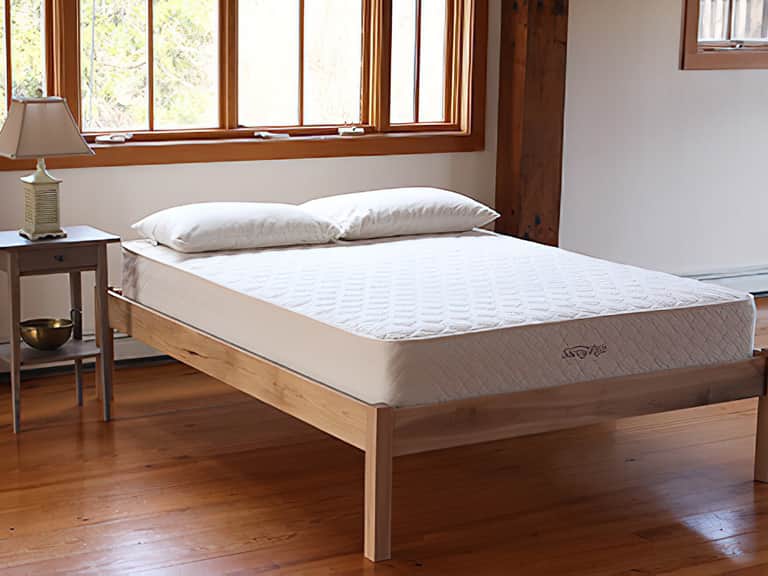
Measure the bed frame and confirm the mattress dimensions, especially if you have an adjustable base or a less common size. If you are buying a new frame, the Savvy Rest Afton Platform Bed is an example of a platform design with closely spaced slats and a five-point support system. Always compare the frame’s specifications with the mattress maker’s requirements before pairing the two.
Also consider finished bed height. The mattress profile, foundation, and frame together determine how high the sleep surface sits. A height that looks balanced in a room may be inconvenient for getting in and out, particularly when combined with a tall mattress or thick topper.
A mattress protector belongs in the plan
Protection is a practical part of caring for a new mattress. A fitted protector can help limit exposure to perspiration, spills, dust, and everyday wear, while a washable surface makes routine care simpler. Choose one that fits the mattress depth and does not noticeably alter the feel or interfere with the care instructions.
Materials and construction matter here, too. A protector may be breathable, water-resistant, or fully waterproof; those terms describe different levels of protection. Review the fabric, backing, laundering directions, and warranty. For a natural mattress, you may prefer a protector whose hand and temperature do not undermine the feel you chose the bed for.
Wash the protector according to its label rather than assuming that high heat, bleach, or fabric softener is harmless. Care requirements can affect the life of the textile and its protective layer. The mattress itself should be cleaned only as directed by its maker; soaking or applying unapproved treatments can damage its materials.
A practical organic mattress comparison checklist
When several options begin to blur together, compare them on the same terms. A concise worksheet can separate meaningful differences from polished but vague product language.
- Materials: Record the cover fabric, comfort layers, support core, quilting, and any other disclosed components.
- Organic claims: Note which specific materials are certified organic and whether the claim covers the complete mattress or selected parts.
- Testing and standards: Write down the exact certification or testing program, what it evaluates, and the documentation available.
- Construction: Compare layer thickness, spring or support design, zoning, edge support, and how the layers are joined.
- Feel: Consider firmness, pressure relief, bounce, motion transfer, and sleeping temperature.
- Fit: Check size, height, foundation requirements, adjustable-base compatibility, and your frame’s support details.
- Care: Review rotation instructions, protector recommendations, cleaning guidance, and warranty exclusions.
- Purchase terms: Confirm trial length, return policy, delivery, setup, removal, and any related charges.
Use the list to expose gaps in the available information. A maker may not publish every construction detail online, but a direct, specific response can help you decide whether the product meets your priorities.
Common assumptions to leave behind
“Natural” and “organic” mean the same thing. They do not. Natural describes an origin in broad terms, while organic usually refers to a defined standard and verified process. Check the actual material and certification language.
A certification guarantees the perfect mattress. A certification can verify specified criteria, but it cannot determine your preferred firmness, ideal sleeping temperature, or personal comfort. Standards inform a decision; they do not make it for you.
More layers automatically mean better quality. A longer ingredient list can make construction harder to understand without improving the fit. Focus on how each layer functions, how materials are documented, and whether the resulting mattress feels supportive to you.
Organic materials need no special care. Natural fibers and carefully made components still benefit from appropriate support, protection, and laundering. Follow the mattress and accessory instructions to avoid preventable wear.
A mattress brand has one consistent recipe. Construction can differ across models and can change over time. Verify the exact model rather than transferring details from another product in the same collection.
How to think about Naturepedic as a reference
Naturepedic is relevant to shoppers researching organic mattresses because it offers a useful point of comparison for questions about materials, product construction, and certification. The most productive comparison is not brand against brand in the abstract, but model against model. Look at the layer diagram, ingredient disclosures, support design, available firmness choices, and certification scope for each mattress under consideration.
Ask whether the listed materials appear throughout the mattress or only in selected layers. Check how the product is intended to feel and what foundation it requires. Then compare those details with the mattress’s trial and care terms. A reference brand can help establish the questions to ask; the answer should still be specific to the bed you plan to bring home.
If a certification, material, or construction detail is central to your decision, confirm it with current product documentation. This is especially useful when the wording on a category page is broader than the specifications for an individual model. Good research is not about collecting the most badges. It is about knowing what each claim actually means.
The considered choice
The most satisfying organic mattress is rarely the one with the longest list of reassuring adjectives. It is the one whose materials are clearly described, whose certifications can be understood, whose construction matches your comfort needs, and whose foundation and care requirements make sense for your home.
Start with the layers. Read the certification details. Think about how you sleep, not just how a mattress looks on paper. Check the base, protector, trial policy, and maintenance guidance. When the product information is precise and the sleep experience feels right, an organic mattress becomes more than a set of claims: it becomes a considered part of a comfortable, well-designed bedroom.